
The Complete Guide to Strata Landed Housing in Singapore: Everything Landed Buyers Need to Know
Most buyers who come to me already know they want landed. What they are less sure about is which kind — and that distinction matters far more than most people realise when they first start looking.
Here is something I have seen play out many times: a buyer falls in love with the idea of a conventional landed home, then gets a quote for waterproofing works, or discovers the roof needs a full replacement, or spends three weekends chasing contractors for a perimeter repaint. Suddenly, the appeal of a strata landed home — where all of that is simply handled — starts to look very different.
That is not to say strata landed is the right answer for everyone. It is a specific format with genuine advantages and real trade-offs, and understanding both will help you decide whether it belongs in your shortlist. This guide walks you through everything you need to know: what strata landed housing actually is, who can legally buy it, how it compares to conventional landed property, and what the ownership experience genuinely looks like day to day.
What Is Strata Landed Housing?
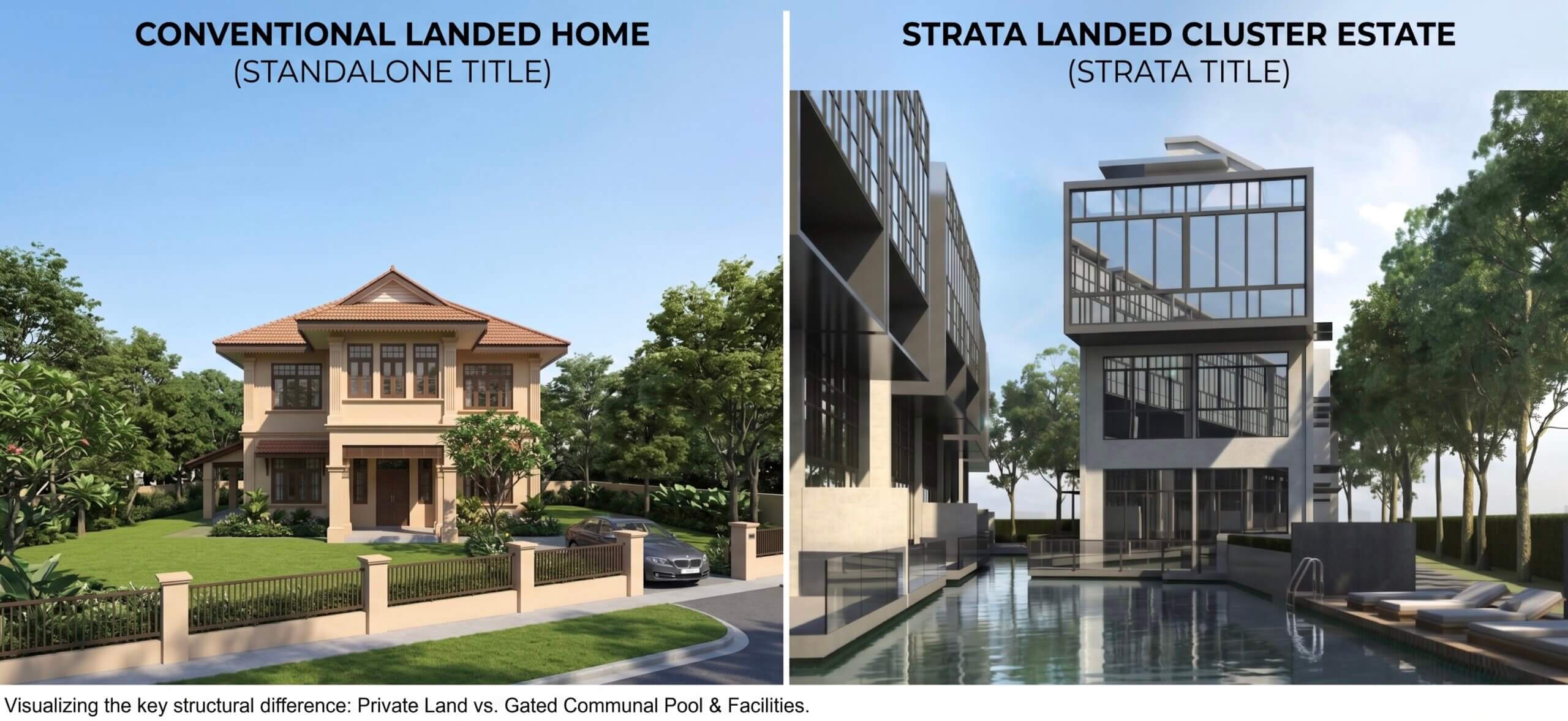
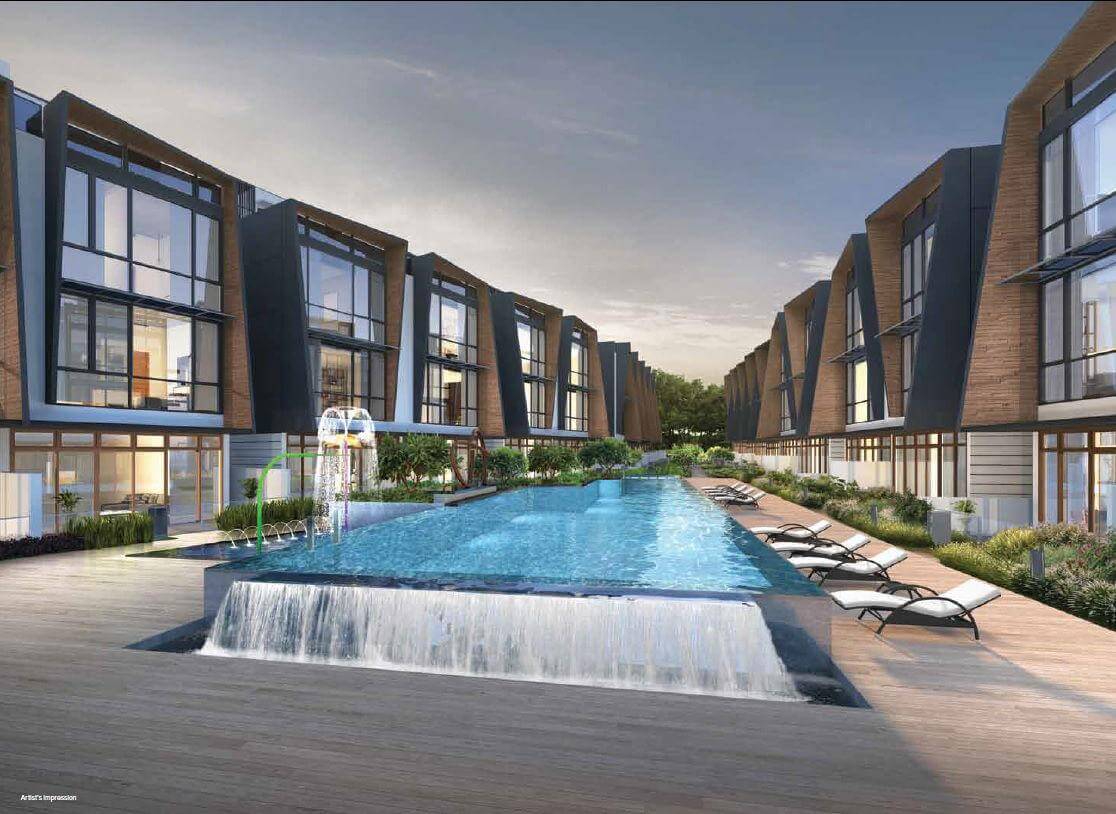
According to the Urban Redevelopment Authority (URA), strata landed housing refers to low-density residential developments that combine the physical form of traditional landed homes — terraces, semi-detached houses, or bungalows — with a shared strata title structure under a Management Corporation Strata Title (MCST) framework.
The key legal difference from conventional landed property lies in the title. With a standard landed home, you hold a Certificate of Title — outright ownership of your specific plot of land. With a strata landed home, you hold a Strata Title. You own the building envelope of your individual unit, but the underlying land is co-owned collectively by all residents in the development as common property.
Think of it this way: your home is entirely yours. The land it sits on, the pool, the gardens, the guardhouse — those belong to everyone in the estate together, governed by the MCST.
The URA permits strata landed developments within designated landed housing estates and mixed-landed zones across Singapore. They typically take the form of cluster developments made up of strata terrace houses, strata semi-detached houses, strata bungalows, or a combination of these. You will also find strata landed units — commonly called townhouses — within larger developments that hold an approved condominium status under the Planning Act.
Some of the most established enclaves for cluster housing in Singapore include Bukit Timah, District 15 along the East Coast, District 19 around Serangoon Gardens and Kovan, and the city-fringe enclave of Braddell Heights Estate in District 13 — a mature, leafy neighbourhood with freehold land, walking distance to Lorong Chuan MRT (CC14) and a short drive to Serangoon MRT interchange (CC13/NE12), and a strong concentration of boutique cluster developments.
Legal Eligibility: Who Can Buy a Strata Landed Home?
This is one of the most misunderstood areas I encounter, particularly among PRs and foreign nationals who are serious about entering the landed segment. The rules hinge on one critical factor: how the development is legally classified.
Under the Residential Property Act (RPA), enforced by the Singapore Land Authority (SLA):
Singapore Citizens may purchase any strata landed development without restriction.
Singapore Permanent Residents (PRs) need to pay close attention to how the development is classified. If it is a pure cluster housing project — not granted overall condominium status under the Planning Act — it is classified as restricted property, and the PR must apply to the Land Dealings Approval Unit (LDAU) of the SLA for formal approval. However, if the unit is a townhouse within a development that holds approved condominium status, no LDAU approval is required.
Foreigners follow the same framework as PRs on this point. Pure cluster homes require LDAU approval. Townhouse units within an approved condominium development do not.
LDAU applications are submitted online and typically take around one month to process. If approval is granted, the buyer must meet additional conditions: the property must be used as a primary residence, occupied for a minimum of five years (the Minimum Occupation Period), and the land size must not exceed 15,000 square feet.
I always advise PR and foreign buyers to clarify the development’s legal classification before making any offer — it affects not just eligibility but also your exit options down the line.
Strata Landed vs. Non-Strata Landed: Similarities and Key Differences
When buyers ask me to compare the two, I start with what they share — because the similarities are what often draw people to strata landed in the first place.
What They Have in Common
Both formats offer genuine multi-storey living, typically across three or more floors. Both sit within low-density residential zones, which means quieter streets, greener surroundings, and a very different pace of life from high-rise living. And both are available across the full tenure spectrum: freehold, 999-year leasehold, and 99-year leasehold.
Where They Diverge
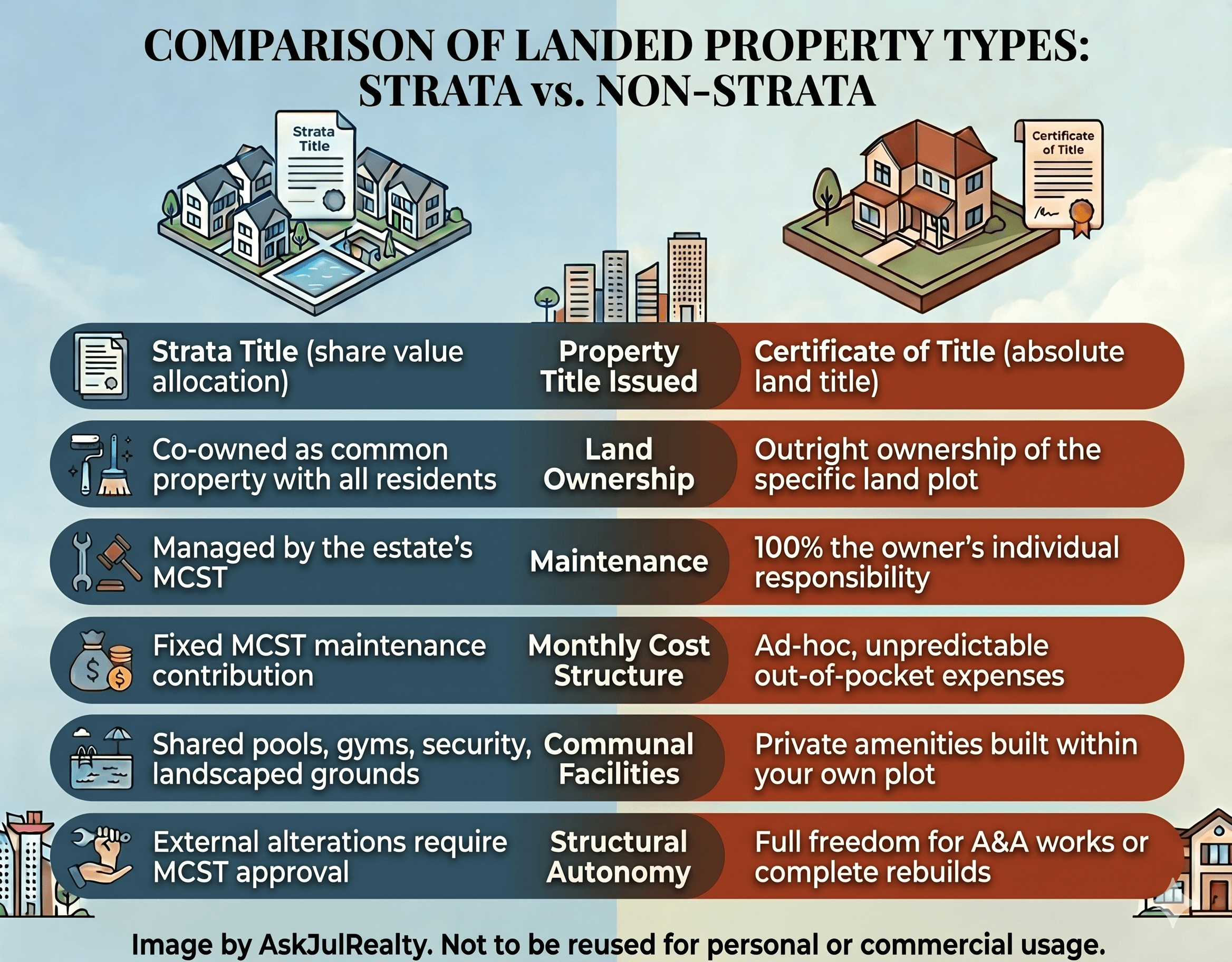
On land ownership: this is the most fundamental legal difference. A conventional landed title gives you absolute ownership of the earth beneath your home. A strata landed title gives you your home — but the land is held in common. For buyers who place high symbolic or strategic value on owning the actual ground, this distinction matters deeply.
On maintenance: I often tell clients that this is where the real day-to-day difference lives. Conventional landed owners are fully responsible for everything — roof leaks, termite treatments, facade repainting, drainage issues. With a strata landed home, the MCST handles all of that externally. You still maintain the interior of your home, but the larger structural and communal responsibilities are off your plate.
On structural autonomy: if you have a strong vision for rebuilding or significantly altering a home, strata landed will constrain you. Any changes to the external facade, roof profile, or structural elements require MCST approval. Internal works are generally fine, but the estate’s architectural uniformity is protected. This is the trade-off that matters most for buyers who think long-term about redevelopment.
Understanding Tenure for Strata Landed Properties
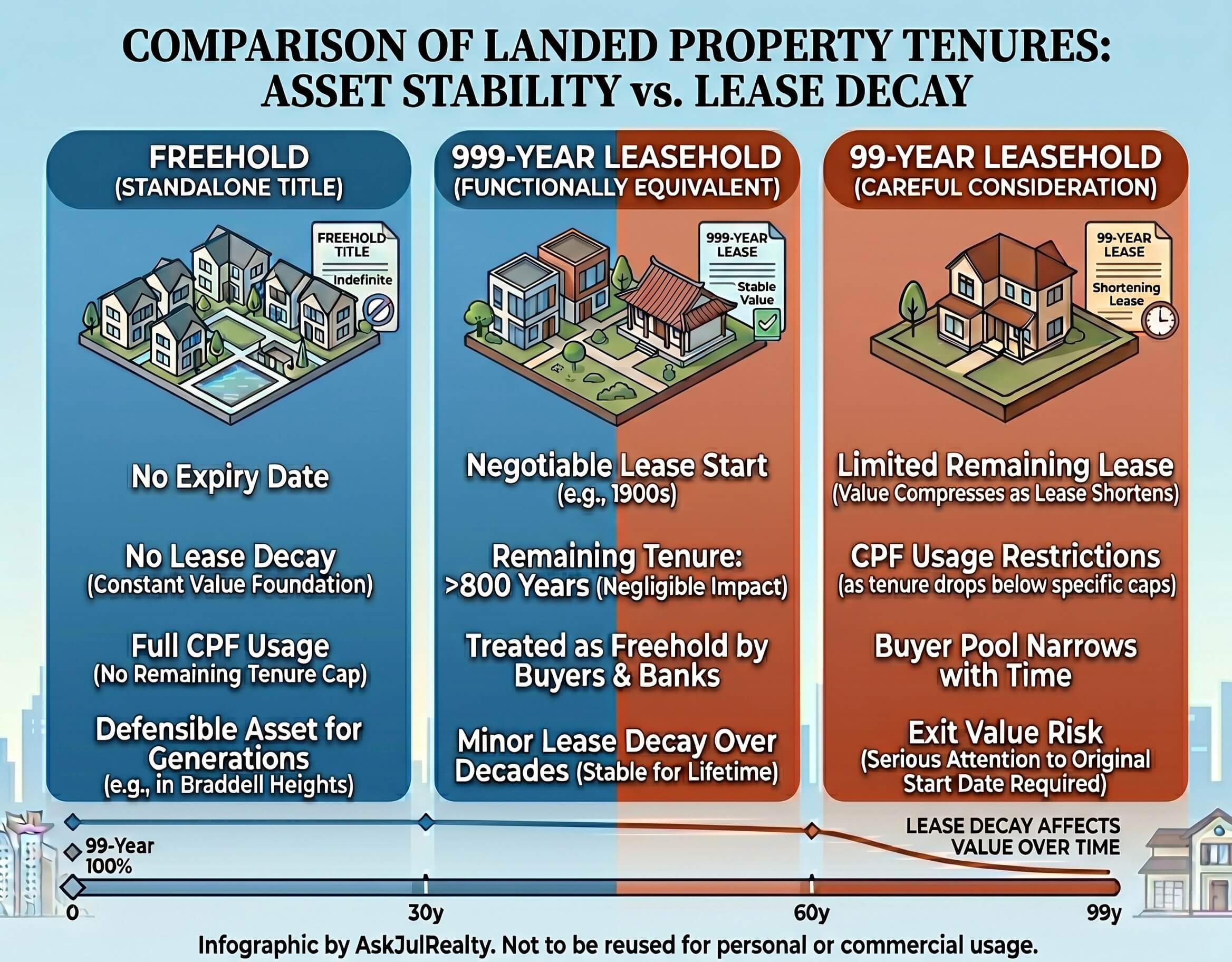
Tenure shapes everything: your financing options, your exit strategy, and how the asset holds value across generations. Here is how the three formats play out in practice.
Freehold is what most serious landed buyers are looking for, and rightly so. There is no expiry, no lease decay, and no CPF restriction tied to remaining tenure. For multi-generational planning, freehold strata landed homes — particularly in established enclaves like Braddell Heights — represent some of the most defensible assets in the Singapore market.
999-year leasehold is treated as functionally equivalent to freehold by most buyers and financiers. The remaining tenure is so long that it has negligible impact on valuation or financing access.
99-year leasehold requires more careful consideration. As the remaining lease shortens, CPF usage becomes restricted and the buyer pool narrows — both of which compress exit values. If you are looking at a 99-year strata landed home, the lease remaining and the original start date deserve serious attention before you commit. For a full breakdown of how leasehold tenure affects your financing, CPF eligibility, and long-term capital outcomes, read our detailed guide on 99-year leasehold landed property in Singapore.
The Pros of Owning a Strata Landed Property
Shared Amenities, Zero Maintenance Headache
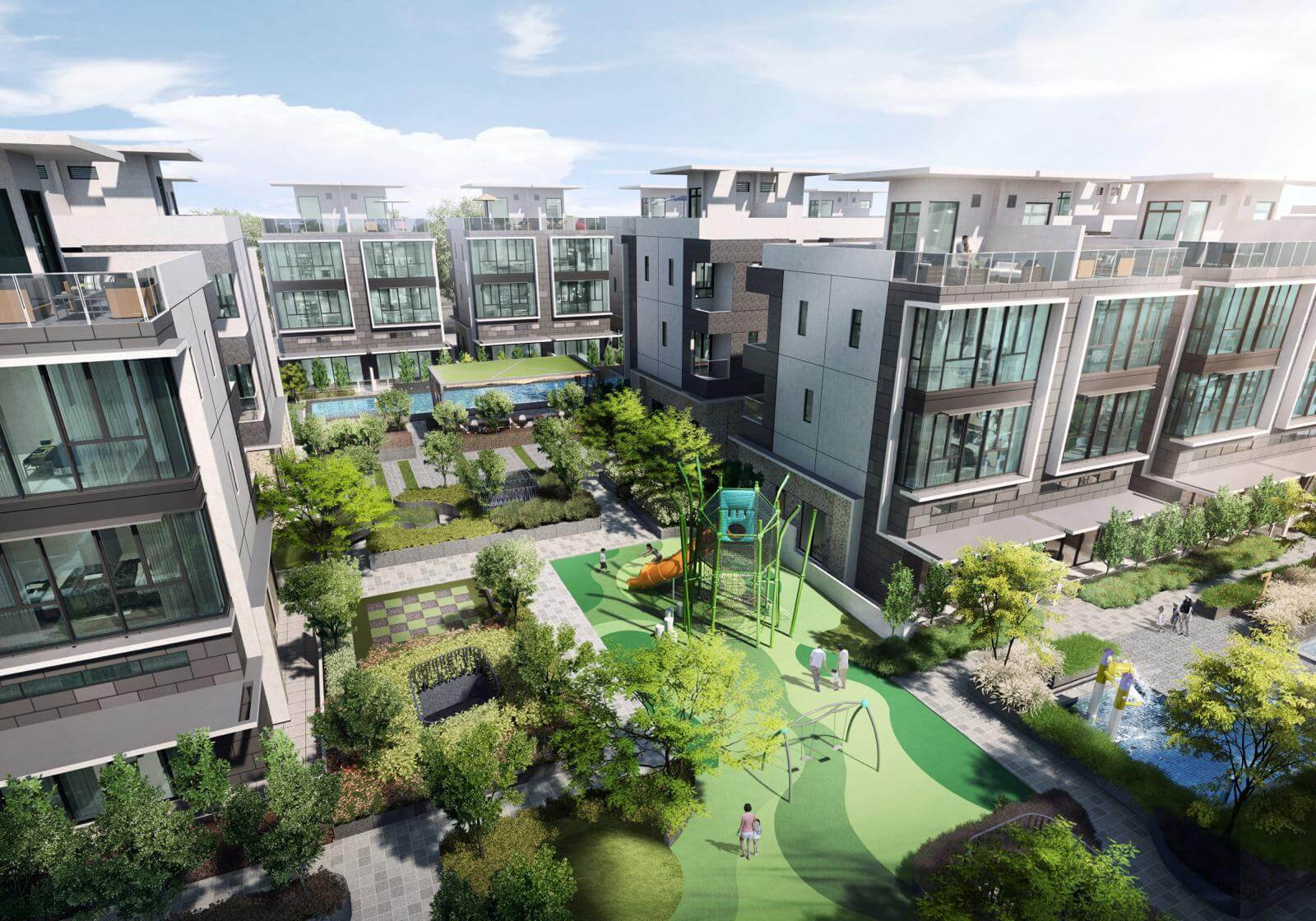
The most immediate lifestyle advantage is access to resort-style facilities — pools, clubhouses, gymnasiums, landscaped gardens — without having to personally build, fund, or maintain them. Under URA development control guidelines for cluster housing, communal open space and greenery provisions are mandated within the development. In practice, residents step into a well-maintained environment from day one, and the MCST keeps it that way.
True Lock-Up-and-Go Living
This benefit tends to resonate most with professionals who travel frequently or families with multiple properties. The MCST handles facade maintenance, roof upkeep, pest control, common area landscaping, and repainting cycles. You do not need to manage contractors, chase quotes, or monitor external works. For buyers who want landed scale without the operational weight of standalone homeownership, this alone can be the deciding factor.
Genuine Security Infrastructure
Most strata landed developments are fully gated, with controlled entry points, perimeter fencing, CCTV coverage, and round-the-clock security personnel. For families with young children or elderly parents, the freedom to move safely within the estate without the anxieties of a public-facing street is something buyers often tell me they undervalued before they experienced it.
Space-Efficient, Developer-Designed Layouts
Because the development is planned as a whole, individual units are typically designed to maximise every floor. Private basement car parking with direct internal access, home lifts, dedicated attic levels, and rooftop terraces are common features — layouts that most individual landowners would struggle to replicate on a standard plot without significant architectural investment.
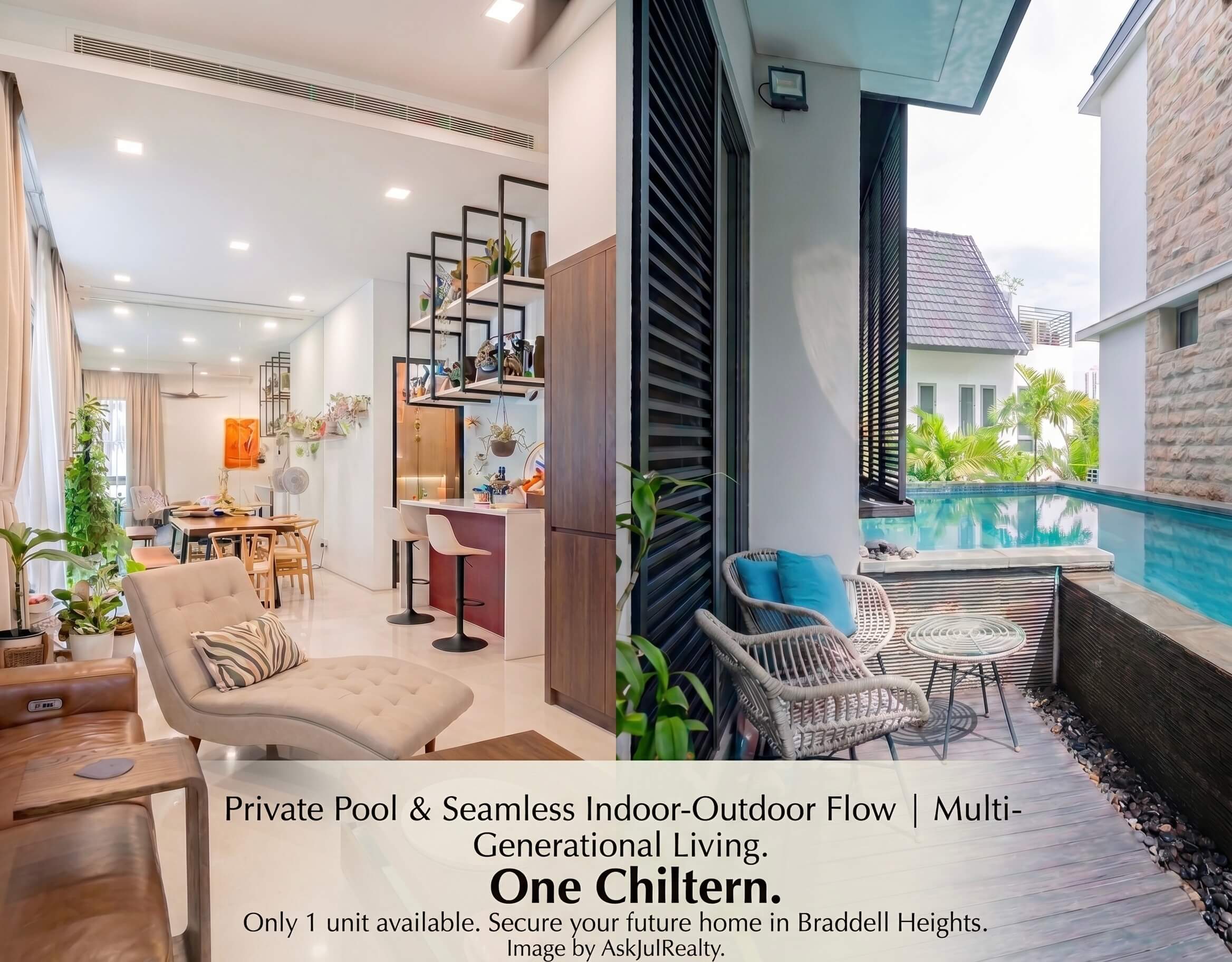
A good example of this is our current listing at One Chiltern, a boutique freehold cluster house development on Chiltern Drive within the Braddell Heights Estate enclave in District 13. It is a short walk from Lorong Chuan MRT, completed in 2006, and offers the kind of three-storey layout with basement parking and communal facilities that shows exactly what well-designed strata landed living looks like in an established neighbourhood. View the listing here.
The Cons of Owning a Strata Landed Property
You Cannot Freely Modify the Exterior
This is the limitation I make sure every buyer fully understands before they proceed. You cannot repaint your facade a different colour, alter your windows, change your roof profile, or make structural changes without MCST approval. The estate’s architectural uniformity is protected — and for good reason, since it preserves the visual consistency and overall asset values of the development. But if you are someone who wants to express your personal vision through your home’s exterior or has plans to rebuild eventually, this constraint will frustrate you.
Monthly Maintenance Fees Are Non-Negotiable
Every strata landed owner contributes a fixed monthly fee to the MCST, covering the Management Fund (day-to-day operations: cleaning, security, landscaping, utilities) and the Sinking Fund (long-term capital works like repainting cycles, lift replacements, and structural repairs). Fees vary based on development size, amenity level, and how efficiently the estate is managed. For strata developments in Singapore, monthly contributions typically range from around $400 to well over $1,000. It is a predictable cost — which helps with budgeting — but it is mandatory regardless of how much you use the shared facilities.
Shared Walls and Shared Spaces
In terrace and semi-detached typologies, you will share party walls with immediate neighbours. The pool, gym, and parking areas are shared by the whole community. For most buyers, this is a fair trade for everything else the format offers. But if your ultimate goal is complete, standalone privacy — the kind only a detached bungalow on a private plot truly delivers — a strata landed home will not fully get you there.
So, Is a Strata Landed Home Right for You?
In my experience, the buyers who thrive in strata landed are those who want the space and exclusivity of landed living, but also value the structure, security, and low-maintenance quality of life that comes with a well-managed estate. It suits families who travel, professionals upgrading from condo living, and multi-generational households who want room to spread out without taking on the full burden of standalone property management.
The buyers who tend to be less satisfied are those who came in wanting to eventually rebuild, those who find shared governance frustrating, or those for whom absolute land ownership carries deep personal or strategic significance.
Neither outcome is wrong. The key is being clear about what matters to you before you commit — and making sure the development you are looking at is the right fit, not just the right format.
If you are at the research stage and want to explore what strata landed living looks like in a real, established setting, Braddell Heights Estate in District 13 is worth your time. It is a freehold enclave within walking distance of Lorong Chuan MRT (CC14) and a short drive to Serangoon MRT interchange (CC13/NE12), a concentration of boutique cluster developments, and the kind of quiet, established residential character that is increasingly hard to find this close to the city.
Ready to Find Your Strata Landed Home?
Whether you are comparing strata landed options, weighing them against conventional landed property, or looking for specific listings in your preferred district, I am happy to walk you through the market with you.
Contact Juliana today for a personalised consultation and access to current strata landed listings across Singapore.
Disclaimer: The information in this article is for general informational and educational purposes only. It does not constitute financial, legal, or investment advice. URA guidelines, SLA regulations, and Singapore property market conditions are subject to change. Readers are advised to conduct independent due diligence and consult qualified property and legal professionals before making any purchase decision. AskJulRealty accepts no liability for decisions made based on the content of this article.


